AI Growth Marketer
Co-Pilots
A co-pilot is a standing assignment. You give it a scope — a channel, a campaign, an area — and a brief describing the goal and the constraints. It then works on that area continuously, deciding what needs doing rather than waiting to be told.
Use it when the work cannot be written down in advance, because the right move depends on what the numbers say that week.
What a co-pilot needs
| Part | Example |
|---|---|
| Scope | Non-brand search, prospecting on Meta, a new campaign's first 30 days |
| Brief | "Grow non-brand conversions while keeping cost per order under $45. Prune waste, test new copy monthly." |
| Limits | Budgets it may work within, changes that always need a person |
What it does with that
- Watches its area and decides what is worth doing
- Executes the work that changes nothing outside Maxma
- Proposes the changes that do, with the reasoning and expected effect
- Reports on a cadence you set, in the app or in Slack
- Records what it learns, so its next proposals start from evidence
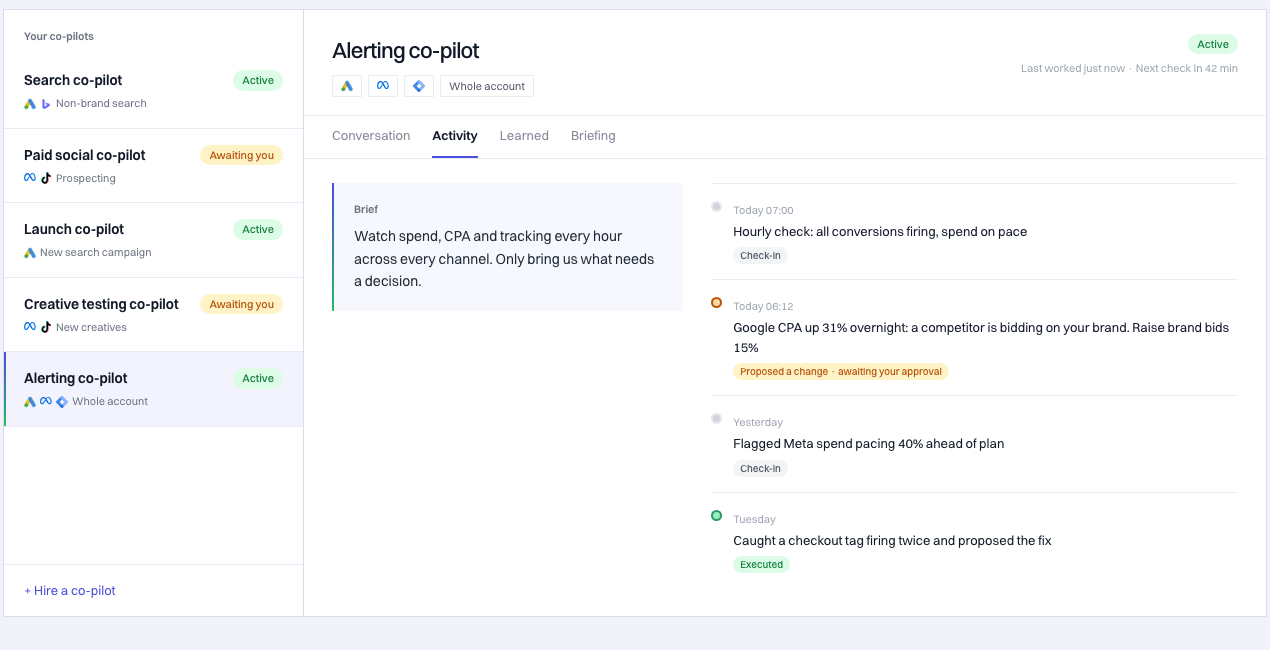
Examples of a scope
- Search: own non-brand search, keep cost per order under target, prune waste, test copy
- Paid social: keep three fresh creatives live in every ad set, retire what tires
- A launch: watch a new campaign closely for its first 30 days
- Creative testing: run every new creative through a fair test, call the winner, cut the losers
- Alerting: watch spend, cost per order and tracking, and only escalate what needs a decision
How it differs from a workflow
A workflow does what you described, when you said. A co-pilot decides what to do inside a scope you set. Workflows suit prescribed work; co-pilots suit judgement work.